Every day, one story that matters, broken down into three numbered scenarios, each with its own probability. Never fixed — it shifts as the situation changes.
Scénario
Wednesday, actualité française
Police & Justice: Can the State Guarantee Public Security?
Faced with a wave of high school blockades and urban unrest, do French police and the judicial system have the resources to protect citizens and process cases within reasonable timeframes?
Publié le 28 octobre 2026
Share:
The facts
The point, in plain terms
French police and justice systems face a dual challenge: containing violent high school blockades while processing everyday criminal complaints.
On one hand, law enforcement is carrying out mass arrests to prevent vandalism around schools. On the other, this emergency mobilization saturates police stations and courts, delaying standard investigations. For citizens, the stakes are immediate: whether the state can maintain public order without further lengthening wait times for all other victims of crime.
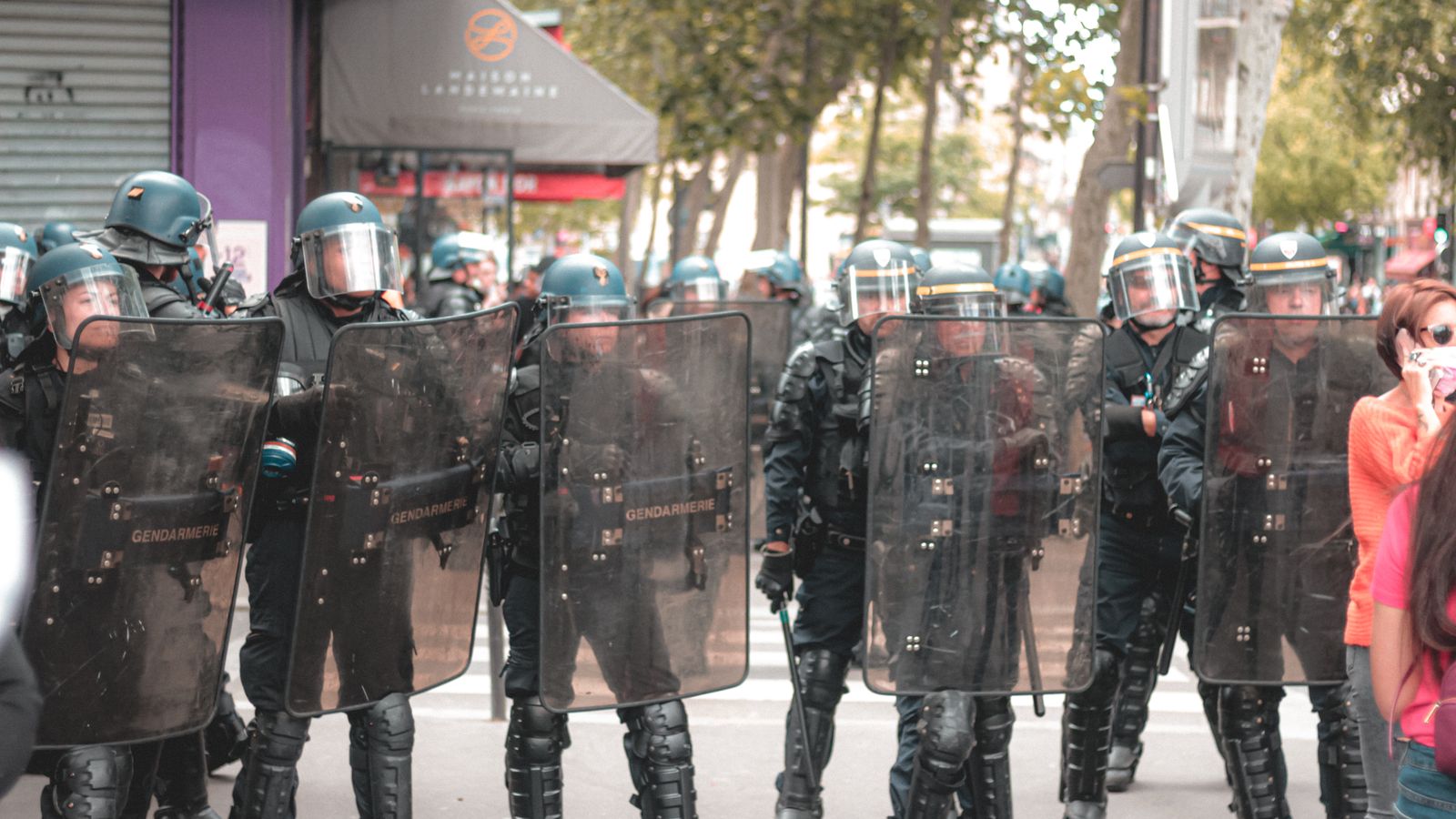
Since mid-September 2026, France has been grappling with unusually intense high school protests. Starting with blockades against academic selection, the mobilization quickly spilled out of school grounds, sparking repeated urban unrest. Interior Minister Laurent Nuñez reported that 158 schools suffered severe damage at the height of the crisis. In an attempt to regain control of the streets, law enforcement stepped up crowd-dispersal operations and mass arrests. On Friday, October 2, 2026, alone, security forces carried out 1,747 arrests, bringing the provisional tally to over 5,000 arrests in a single week of unrest.
This unprecedented police response highlights severe strains on public order management. The use of intermediate weapons has sparked intense controversy, particularly after several severe injuries caused by rubber-bullet launchers (LBDs)*. In Saint-Ouen-l'Aumône, a 14-year-old sustained a double jaw fracture during a police operation. The National Police Internal Affairs Bureau (IGPN)* opened several separate investigations to examine whether the shots were proportionate. The Defender of Rights* also launched an investigation on its own initiative to review compliance with professional ethics, underscoring the growing rift between mobilized youth and the institutions tasked with their safety.
Behind the immediate crisis on the ground, the entire criminal justice system is coming under severe strain. Facing a surge in police custodies, Justice Minister Gérald Darmanin issued a firm directive to prosecutors on October 2, 2026. The guidance instructs immediate prosecution of offenders, systematic confiscation of mobile phones when assaults are filmed, and increased reliance on parental civil liability*. As of October 9, 2026, the Ministry of Justice had already logged 6,877 individuals held in police custody, 86% of whom were minors, resulting in 2,376 criminal prosecutions. Magistrates are forced to fast-track these cases even as courts suffer from severe staffing shortages.
Understanding it
Parental civil liability: paying for damage caused by minors
Under French law, parents are automatically liable for damage caused by their minor children living under their roof. If a high school student damages street furniture or sets fire to a trash bin, the court can compel their family to fully reimburse repair costs to the municipality or victims.
This sudden reallocation of personnel toward urban unrest worsens a long-standing vulnerability in criminal investigations. When police officers and court clerks are consumed by fast-track processing and protest management, core investigations into everyday offenses suffer substantial delays. According to the official statistical report on domestic security, the one-year clearance rate* for fraud and breach of trust dropped from 31% in 2017 to 15% in 2023. Over six years, investigators' capacity to resolve these widespread offenses was cut in half, leaving thousands of victims without timely judicial recourse.
Understanding it
Clearance rate: measuring the cases police successfully solve
This metric compares the number of resolved investigations with an identified suspect against the total number of filed complaints. When this rate drops from 31% to 15%, it means that out of one hundred reported fraud cases, police now solve only fifteen over the course of a year due to lack of time and available investigators.
To patch these vulnerabilities, the government is attempting to overhaul its investigative units and procedural rules. Laurent Nuñez announced the recruitment of 700 additional investigators to bolster criminal investigation divisions, while the July 23, 2026 law on criminal justice and victims' rights establishes new rules set to partially take effect on January 1, 2027. However, training judicial police officers and adapting court operations takes years. Caught between the urgency of securing high schools and the need to process everyday complaints, the state's budgetary and human trade-offs are reaching a critical threshold.
The balance of public safety in France now hinges on authorities' ability to quell the unrest without eroding public trust. While the government pledges a swift return to calm, backlogged courts and exhausted security forces make any exit from the crisis uncertain. Three scenarios emerge through the end of the year: a gradual easing achieved through political dialogue and financial deterrence, a high-tension stalemate where the justice system handles emergencies at the expense of everyday cases, or an escalation of urban unrest that chronically overwhelms police and courts.
Cumulative arrests at the peak of the week of October 2, 2026over 5,000 arrests including 1,747 on Friday, October 2, 2026 alone
One-year clearance rate for fraud and breach of trust15% in 2023 down from 31% in 2017 (a 16-point drop over six years)
Les chiffres
La police judiciaire élude de moins en moins vite les escroqueries et abus de confiance : le taux à un an a chuté de 16 points en six ans.
2017
31 %
2021
17 %
2023
15 %
Source : SSMSI, Bilan statistique de la sécurité intérieure 2024 (Ministère de l'Intérieur), données 2017-2023.
Three Trajectories for Security and Justice in the Face of Urban Unrest
What we're assessing
FavorableLe dialogue politique calme la rue et les sanctions financières parentales freinent rapidement les dégradations.
StableLes blocages persistent sous contrôle policier mais l'engorgement judiciaire continue de retarder les dossiers courants.
DégradéDe nouvelles violences graves embrasent les quartiers et saturent complètement les commissariats et les tribunaux.
Favorable
25%
Unlikely
Political compromise restores calm and clears judicial bottlenecks
In this first scenario, negotiations led by the Prime Minister's office and the Ministry of National Education yield concrete compromises on exam conditions and school resources. High school student assemblies vote to lift pickets, prompting an immediate drop in gatherings and property damage around the 158 vulnerable schools. Strict enforcement of financial liability on families acts as a swift deterrent, encouraging parents to keep closer watch over minors in the evening. Law enforcement scales back emergency deployments, and police stations return to normal operations.
Our assessment assigns a 25% probability to this trajectory, as high school grievances run deep and are difficult to defuse with administrative promises alone. If realized, this scenario would allow the 700 new investigators promised under the investigation plan to focus fully on pending cases. Courts would absorb the 2,376 prosecutions arising from the crisis without paralyzing other civil and criminal proceedings. The overall efficiency of the judicial system could then steadily rebound starting in early 2027.
In practice, classes would resume uninterrupted across all high schools, and victims of everyday offenses would see their complaints processed faster as police stations unclog.
Indicators affected
Interpellations hebdomadairesRetour sous 200 par semaine↓plus de 5 000 en semaine de crise
Taux d'élucidation des escroqueriesRemontée visée vers 20 %↑15 % en 2023
The France angleA return to calm in schools protects municipal budgets and enables courts to clear their backlog. ↑ Rather favorable for France.
Stable
50%
Likely
Protests persist under heavy policing, saturating the courts
In this second scenario, school blockades and skirmishes continue in intermittent waves across major metropolitan areas. The Interior Ministry maintains heavy police deployments, preventing widespread looting but resulting in hundreds of arrests each week. Magistrates continue to enforce strict directives, handling urban unrest cases through immediate summary trials or expedited juvenile hearings. This day-to-day crisis management monopolizes security resources and stalls structural reforms within the criminal investigation units.
The most probable scenario (50%) points to a high-tension status quo where the state manages to contain street protests without resolving the gridlock in its criminal justice system — the other two scenarios being negotiated appeasement (25%) and uncontrolled escalation (25%). Frontline officers remain tied down on public thoroughfares rather than investigating everyday offenses. The clearance rate for financial crimes and burglaries stagnates at its historic low of 15%, while court delays for routine disputes stretch by several additional months.
In practice, high schools would remain guarded by police cordons, and ordinary citizens would have to wait even longer for cases involving burglaries or fraud to reach court.
Indicators affected
Interpellations hebdomadairesMaintien entre 800 et 1 500 par semaine→plus de 5 000 en semaine de crise
Taux d'élucidation des escroqueriesStagnation autour de 15 %→15 % en 2023
The France angleOrder is maintained at the cost of a slower justice system for all victims of routine offenses. ↓ Rather unfavorable for France.
Degraded
25%
Unlikely
Escalating urban unrest overwhelms law enforcement and the justice system
In this third scenario, fresh severe injuries from crowd-control munitions or pyrotechnic mortar attacks ignite widespread unrest across several suburbs. University student and union protests merge with high school blockades, multiplying flashpoints nationwide. Law enforcement, exhausted after weeks of non-stop crowd-control duties, struggles to secure city centers and public transit. Police station holding cells exceed capacity, forcing prosecutors to drop numerous minor offenses due to a lack of resources to process them.
We evaluate the risk of such institutional breakdown at 25% should IGPN or Defender of Rights investigations uncover systemic misconduct that fuels public anger. Under this hypothesis, courts would be entirely consumed by riot-related cases, effectively halting ordinary hearings. A sense of impunity would grow for everyday crime, deepening public distrust in the justice system and plunging state authority into a lasting crisis of legitimacy.
In practice, property damage would surge in cities, and backlogged police stations would no longer be able to effectively log and handle complaints from the public.
Indicators affected
Interpellations hebdomadairesFlambée au-delà de 3 000 par semaine↑plus de 5 000 en semaine de crise
Taux d'élucidation des escroqueriesNouvelle chute vers 10 %↓15 % en 2023
The France angleA severe security crisis would weaken the urban economy and chronically paralyze the courts. ↓ Rather unfavorable for France.
Ordres de grandeur indicatifs pour les 3 scénarios ci-dessus, estimés avec l'information disponible à la publication et réévalués si la situation change — jamais des prévisions garanties. Learn more about our method → · How to read a probability →
Key takeaways
Amid urban unrest triggered by high school blockades, can French police and courts maintain public order while ensuring acceptable processing times for all citizens seeking justice?
The unrest led to 1,747 arrests on October 2, 2026, and over 6,877 individuals held in custody within three weeks, while clearance rates for everyday offenses such as fraud had already plummeted from 31% to 15% between 2017 and 2023.
Not entirely: our most likely scenario (50%) indicates that the state will contain street protests through massive police presence, but at the cost of prolonged court gridlock that delays everyday complaints — two other scenarios remain possible: negotiated de-escalation (25%) or uncontrolled flare-ups (25%).
The key indicator to monitor is the weekly trend in juvenile custodies and the findings of IGPN investigations into the use of LBDs by mid-November 2026.
Moderately negative
Our assessment of the impact for France: moderately negative.the combined 75% probability of sustained tensions or escalation places an excessive burden on courts and worsens the handling of everyday complaints for citizens.
Si tu devais retenir 1 chose
Avec plus de 5 000 interpellations en une semaine et un taux d'élucidation des escroqueries tombé à 15 %, la police et la justice françaises sont sous tension maximale.
Don't miss the next edition:
For those new to the topic
Quick glossary
rubber-bullet launchers (LBDs)
Non-lethal weapon used by law enforcement to fire rubber projectiles designed to incapacitate individuals at a distance.
National Police Internal Affairs Bureau (IGPN)
Internal oversight agency responsible for monitoring police conduct and investigating alleged professional misconduct or illegitimate force.
Defender of Rights
Independent constitutional authority ensuring the protection of civil liberties, public service users' rights, and security ethics.
parental civil liability
Legal obligation requiring parents to financially cover property damage and vandalism committed by their minor children.
clearance rate
Percentage of recorded offenses for which police or gendarmerie investigators successfully identify and bring charges against a perpetrator.