Every day, one story that matters, broken down into three numbered scenarios, each with its own probability. Never fixed — it shifts as the situation changes.
Scénario
Friday, science
Euclid: Can the first map of the Universe unlock dark energy?
Will Euclid’s first cosmic map revolutionize our understanding of dark energy, or confirm existing models without major surprises?
Publié le 20 novembre 2026
Share:
The facts
The point, in plain terms
The European space telescope Euclid has just released its first giant map of 900 million galaxies to measure the expansion of the cosmos.
Astrophysicists are seeking to understand dark energy, an invisible force stretching the Universe at an accelerating rate. Current theory posits that this force never changes, yet no one knows what it truly is. This discovery will not change daily life on Earth. What is at stake is whether our current laws of physics accurately describe how our Universe works or whether textbooks will have to be rewritten.
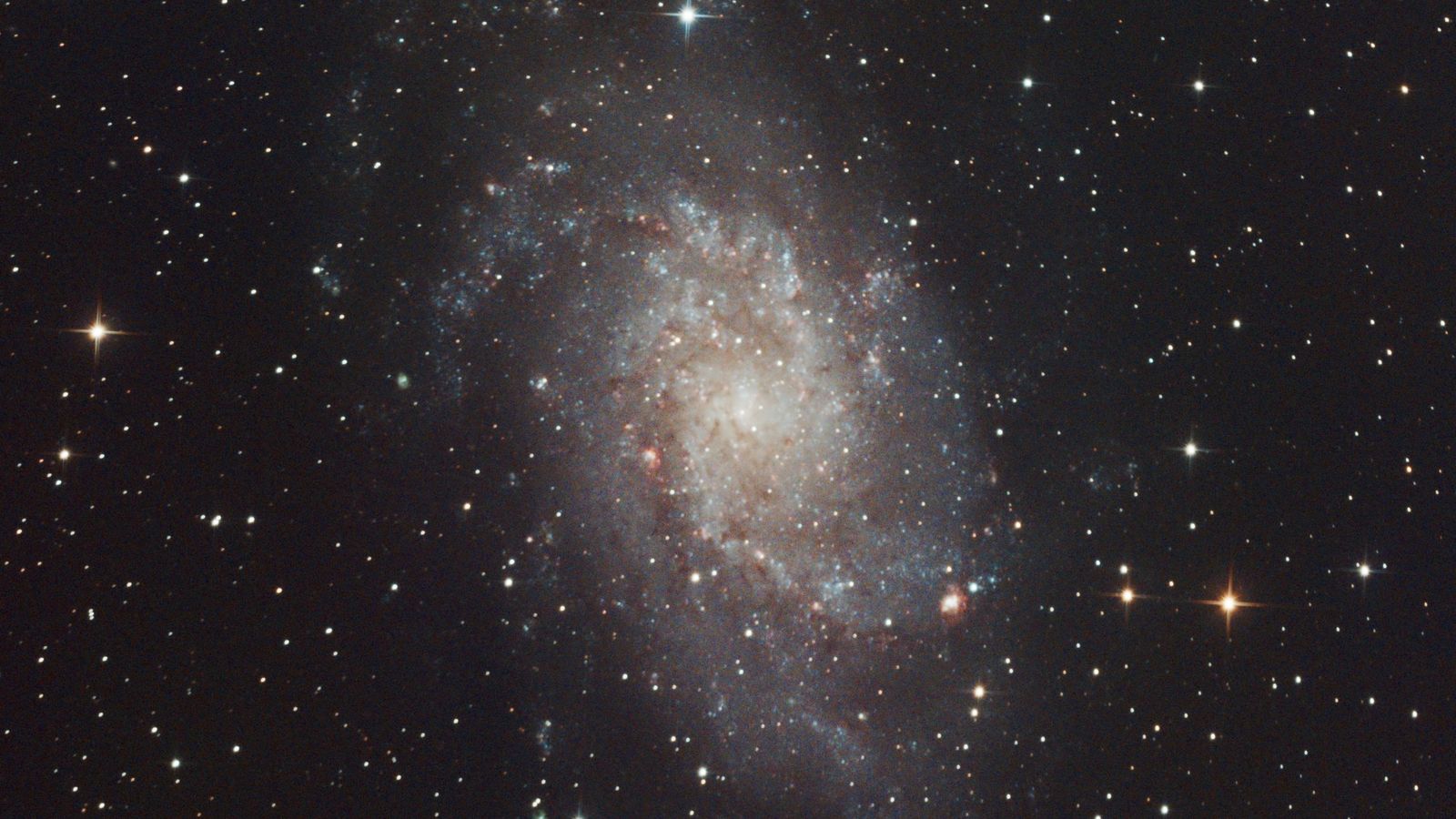
On November 13, 2026, the European Space Agency reached a major milestone in the history of astronomy. Its Euclid space telescope, launched into orbit in July 2023, released its very first giant public data catalog. In just over a year of observations, the instrument has already surveyed more than one billion celestial objects across the cosmos. Among them are 900 million distant galaxies observed with remarkable clarity. This spectacular harvest far surpasses all previous space-based surveys, laying the foundations for the largest 3D map ever created of our observable Universe.
To understand what is at stake, the Universe can be pictured as a vast cosmic web* where matter is arranged in long interconnected filaments. However, the stars, planets, and gas we can see make up only about 5% of the total cosmos. Everything else remains invisible to conventional instruments. On one hand, dark matter* acts as an invisible gravitational glue that prevents spinning galaxies from flying apart. On the other, dark energy* acts in reverse as a repulsive force accelerating the expansion of space on a grand scale.
Understanding it
Dark energy acts like an invisible cosmic rubber band stretching faster and faster.
Picture two ants sitting on an inflating balloon. Even if they stay still, the distance between them grows because the balloon’s surface is expanding beneath their feet. Dark energy acts the same way on the space between galaxies, accelerating this continuous expansion over billions of years.
The standard scientific theory, known as the cosmological model* or Lambda-CDM model, describes dark energy as a cosmological constant that is immutable across time and space. According to this established mathematical framework, this mysterious force has maintained precisely the same strength since the Big Bang nearly fourteen billion years ago. Until now, however, measuring instruments lacked the precision to verify whether this force varies slightly or remains perfectly stable. Euclid was designed specifically to settle this fundamental debate by measuring the positions and shapes of hundreds of millions of galaxies.
To measure distances to these distant objects, researchers use the redshift* of the light emitted by each galaxy. The faster a galaxy moves away due to cosmic expansion, the more its light stretches toward longer wavelengths. Thanks to a high-tech instrument developed under the leadership of the Laboratoire d’Astrophysique de Marseille in France, Euclid has already measured more than 160 million light spectra. Astronomers are also tracking gravitational lenses*—optical mirages where the gravity of an invisible mass bends the path of background light.
Understanding it
Mapping one billion objects makes it possible to reconstruct a 3D movie of the cosmos.
Observing galaxies at varying distances is like flipping through a photo album of the Universe at different stages of its life. The farther a galaxy is, the longer its light took to reach us. By combining 900 million snapshots, Euclid reconstructs the history of matter over the past ten billion years.
The arrival of this initial dataset opens a period of intense excitement in laboratories worldwide. Scientists are painstakingly analyzing galaxy positions to check whether the cosmic web unfolded exactly as standard theory predicts. If the findings show a tiny yet consistent deviation from calculations, physicists will have to devise a new theory of gravity to explain how nature truly works. Conversely, if everything matches perfectly, the current theory will be reinforced, but the mystery surrounding the inner physical nature of dark energy will remain unsolved.
By 2030, the full mission aims to map up to 1.5 billion galaxies across a third of the celestial vault. However, the release of the first detailed cosmological results in mid-2027 will serve as the initial litmus test. To shed light on the future of this cutting-edge research, the Scénarios editorial team explores three possible paths: a major theoretical breakthrough upending our laws of physics, a solid confirmation of the existing model, or unforeseen methodological hurdles temporarily delaying scientific conclusions.
Mapped galaxies (DR1-Foundation)900 million 14% of final sky covered by late 2026
Total celestial objects (Full DR1)1 billion+ First public catalog of November 2026
Les chiffres
Euclid a déjà cartographié 900 millions de galaxies dans sa première release, contre 0,1 million pour le Hubble Deep Field en 1995 — une avancée de plusieurs ordres de grandeur.
Hubble Deep Field (1995)
0,1 million (1995)
Euclid DR1-Foundation (2026)
900 millions (2026)
Euclid mission complète (prévision 2030)
1 500 millions (prévision 2030)
Source : LAM (DR1-Foundation, 18/11/2026) et ESA (13/11/2026)
Three scenarios for discoveries from the Euclid telescope
What we're assessing
FavorableEuclid détecte des anomalies nettes et force les physiciens à inventer une nouvelle théorie du cosmos.
StableLes mesures confirment le modèle standard actuel avec une précision sans précédent mais sans surprise.
DégradéDes biais de mesure ou des défauts d'analyse retardent les conclusions scientifiques sur l'énergie noire.
Favorable
25%
Unlikely
Data reveals a crack in the standard theory of the Universe
First scenario: statistical measurements from Euclid’s first catalog reveal significant discrepancies with the mathematical predictions of the standard cosmological model. By analyzing the spatial distribution of galaxy clusters and the slight distortions caused by gravitational lensing, teams discover that dark energy varies over cosmic time. In practice, this invisible force would not behave as a simple fixed constant, but as a dynamic fluid whose density evolves across billions of years. Such an anomaly would force theorists to overhaul Albert Einstein’s equations of general relativity across the entire cosmos.
Compared to a reassuring confirmation or a methodological delay, this trajectory would represent the century’s most significant scientific discovery in fundamental physics. It would provide experimental proof that our current theoretical models are incomplete in describing cosmic expansion. Public funding and global research efforts would pivot massively toward new theoretical avenues, giving European laboratories a decisive lead over international competitors. This conceptual shift could pave the way for a scientific revolution on par with the rise of quantum physics in the early twentieth century.
Indicators affected
Galaxies cartographiées (DR1-Foundation)900 millions analysées avec anomalies confirmées↑900 millions (base de départ)
Objets célestes totaux (DR1 complet)1 milliard+ d'objets servant à recalibrer les lois↑1 milliard+ (catalogue brut)
The France angleThe Laboratoire d’Astrophysique de Marseille and CNRS would be at the center of modern physics’ greatest discovery. ↑ Rather favorable for France.
Stable
55%
Fairly likely
The standard model is reinforced with unprecedented observational precision
Second scenario: in-depth analyses of galaxy positions fully confirm the prevailing theory of the cosmological constant. All measurements of expansion rate and spatial curvature fall squarely within the tolerance margins predicted by the Lambda-CDM model. In practice, dark energy continues to appear as an intrinsic, invariant property of empty space, without the slightest trace of fluctuation across time or space. Astrophysicists achieve ten times greater measurement precision than previous missions, ruling out numerous alternative exotic physics hypotheses without directly uncovering the microscopic nature of this force.
Unlike the scenario of a spectacular breakthrough or a technical impasse, this outcome validates the remarkable robustness of theories developed over several decades by the scientific community. Even without an immediate conceptual revolution, these refined data make it possible to set extremely tight bounds on cosmic particle masses and the overall geometry of the Universe. Euclid would thus fully deliver on its initial scientific mandate for the European Space Agency, providing scientists with a robust framework to guide future space observatories planned for the following decade.
Indicators affected
Galaxies cartographiées (DR1-Foundation)900 millions confirmant le modèle standard→900 millions (catalogue initial)
The France angleFrench space engineering and LAM instruments see their reliability praised worldwide. ↑ Rather favorable for France.
Degraded
20%
Unlikely
Measurement uncertainties and instrumental biases delay answers
Third scenario: data processing encounters unforeseen hurdles related to optical effects or poorly modeled intergalactic dust. Researchers discover that certain light-distortion signals are tainted by instrumental artifacts that prove difficult to correct. In practice, the statistical margin of error remains too high to determine with certainty whether dark energy deviates from standard theory. Teams must postpone the release of their major cosmological findings to thoroughly overhaul image-cleaning algorithms, pushing definitive scientific interpretations back by several years.
Compared to the previous two scenarios offering clear-cut answers, this situation would prolong a frustrating period of uncertainty for European astrophysics. The mission would not be a complete scientific failure, as individual images remain exceptionally rich and detailed for studying nearby stars. However, the overarching goal of solving the mystery of cosmic acceleration would lose its time advantage over competing ground-based projects led by American observatories. The global cosmological debate would then enter an extended holding pattern until the full release of the final catalog in 2030.
Indicators affected
Galaxies cartographiées (DR1-Foundation)900 millions nécessitant des recalibrations↓900 millions (première estimation)
The France angleFrench research teams would have to dedicate months of additional computation to fix processing pipelines. ↓ Rather unfavorable for France.
Ordres de grandeur indicatifs pour les 3 scénarios ci-dessus, estimés avec l'information disponible à la publication et réévalués si la situation change — jamais des prévisions garanties. Learn more about our method → · How to read a probability →
Key takeaways
Can the first data release from the Euclid space telescope finally unveil the hidden nature of dark energy, or will it merely confirm established theories?
Launched in 2023 by the European Space Agency, Euclid released a colossal survey on November 13, 2026, featuring 900 million galaxies and more than one billion celestial objects.
No immediate revolution expected: our most likely scenario (55%) sees the data confirming the standard cosmological model with record precision—while two other paths remain open: an unexpected theoretical breakthrough (25%) or methodological delays (20%).
Signal to watch: the publication of the first joint cosmological analysis papers on dark energy scheduled for mid-2027.
Fairly positive
Our assessment of the impact for France: fairly positive.France is one of the mission’s key architects thanks to the NISP spectrometer developed by the Laboratoire d’Astrophysique de Marseille, securing privileged data access for national researchers across 80% of our analysis scenarios (55% confirmation scenario and 25% theoretical breakthrough scenario).
Si tu devais retenir 1 chose
Avec 900 millions de galaxies cartographiées dès sa première livraison de novembre 2026, le télescope spatial Euclid pose les bases de la plus vaste carte 3D de l'Univers pour tester la théorie de l'énergie noire.
Don't miss the next edition:
For those new to the topic
Quick glossary
cosmic web
Gigantic network structure where galaxies cluster along long filaments of matter separated by vast voids.
dark matter
Invisible form of matter that emits no light, but whose gravitational pull holds galaxies together.
dark energy
Mysterious repulsive force permeating all space that has been accelerating the expansion of the Universe for billions of years.
cosmological model
Standard theoretical framework (also known as Lambda-CDM) describing the history, composition, and evolution of the observable Universe.
redshift
Stretching of light toward redder wavelengths caused by a receding galaxy, used to determine its distance.
gravitational lenses
Distortion of a background galaxy’s image caused by the mass of a massive object lying along the path of light.