Every day, one story that matters, broken down into three numbered scenarios, each with its own probability. Never fixed — it shifts as the situation changes.
Scénario
Tuesday, science
Moon: The Race for Water Ice
Is the ice in lunar polar craters a strategic reservoir to tap by 2035, or a scientific and legal trap?
Publié le 29 septembre 2026
Share:
The facts
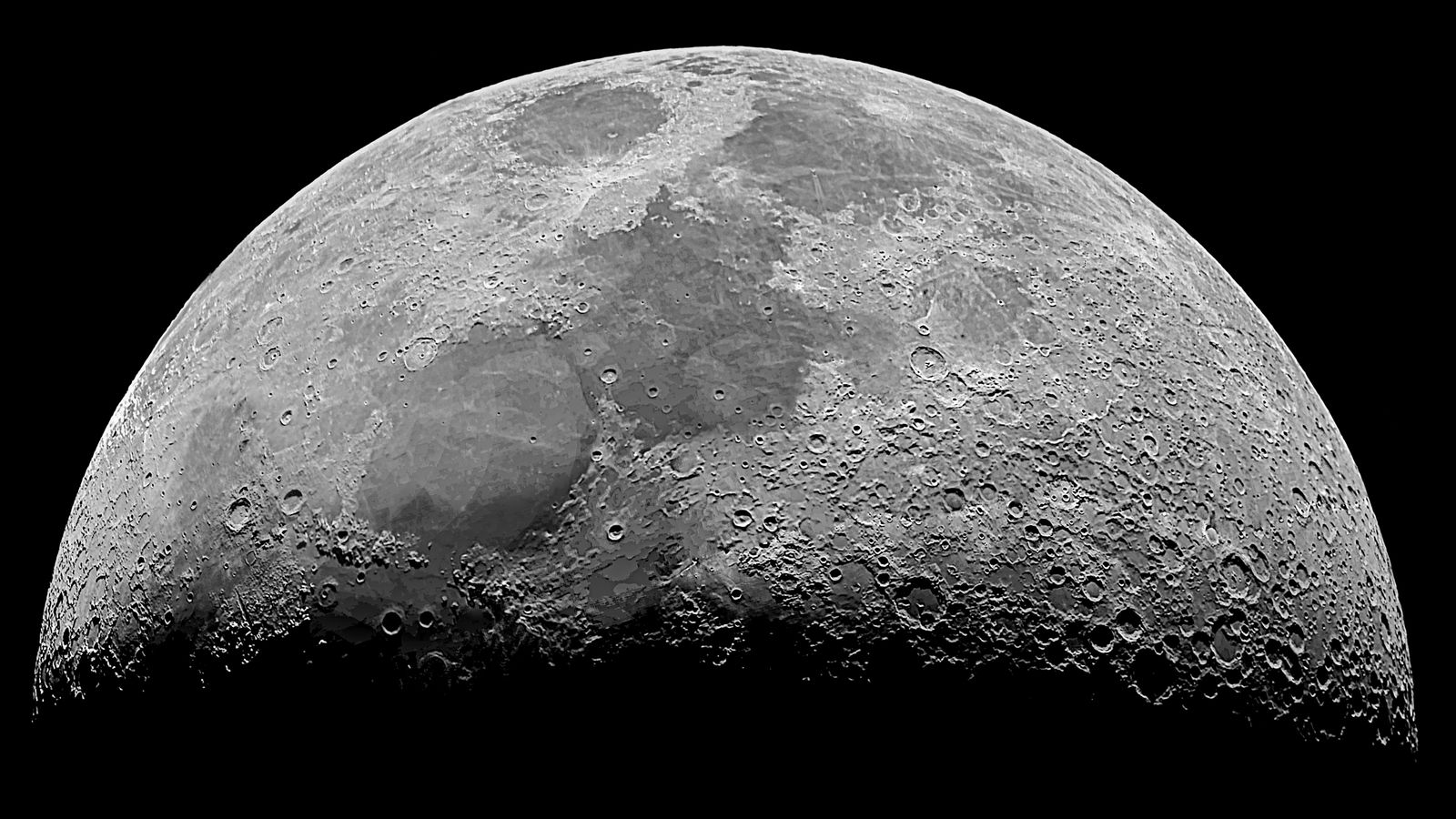
Space exploration is no longer just about planting a flag on lunar soil, but establishing a lasting presence. At the heart of this new international rivalry lies a resource long thought nonexistent on our natural satellite: water. Ever since the findings of the LCROSS mission in 2009, the scientific community has known that craters at the lunar poles, shrouded in perpetual darkness, harbor vast deposits of water ice. Scientists estimate these reserves at 600 billion metric tons of water ice trapped in extreme cold, where temperatures plunge below minus two hundred degrees Celsius. This discovery has dramatically reshaped the Moon’s geopolitical value, transforming it from a barren desert into a strategic outpost coveted by the world’s major powers.
To understand this sudden surge of interest, one must consider the logistical hurdles of space travel. Escaping Earth’s gravitational pull means every single kilogram of orbital payload costs a fortune in propellant and launch hardware. The water ice at the lunar poles is not merely intended to quench the thirst of future astronauts: it is the vital raw material needed to manufacture rocket fuel. By splitting the water molecule through electrolysis—a chemical process that separates hydrogen and oxygen—space agencies hope to produce liquid fuel and oxidizer directly on-site. This concept of using local resources, known as *ISRU (in-situ resource utilization), would drastically slash the mass launched from Earth and open up a logistical corridor toward Mars.
Understanding it
Lunar water: a natural gas station for deep-space travel
Launching fuel from Earth requires massive amounts of energy to overcome gravity. Finding water on the Moon allows it to be split into hydrogen and oxygen for direct refueling on-site—much like finding a gas station at the base of a mountain instead of carrying all your fuel up on your back.
Faced with this opportunity, two rival space coalitions are positioning themselves to be the first to reach the volatile-rich polar zones. On one side, the United States leads NASA’s Artemis program, partnering with the European Space Agency (ESA) and private players like SpaceX. Their official goal targets a crewed return as early as 2026 with the Artemis 3 mission, even though industrial and technical bottlenecks cast serious doubt on that timeline. On the other side, China is advancing methodically through its Chang’e program: following the historic feat of the Chang’e 6 mission, which brought back samples from the far side in June 2024, Beijing and its Russian partner are developing the International Lunar Research Station (ILRS) with the ambition of landing taikonauts around 2030.
Yet bridging the gap between detecting traces of water and industrial-scale extraction involves monumental technical hurdles. Lunar ice is not a smooth skating rink easy to cut through, but a dense mixture of rock dust and frozen grains embedded in the *regolith (the abrasive layer of dust blanketing lunar bedrock). Extracting this water will require autonomous excavators capable of withstanding dust as sharp as crushed glass, alongside nuclear power plants or giant solar mirrors stationed on crater rims to heat the rock without freezing electronic circuits. The development cost of these miniature extraction facilities currently far exceeds the exploration budgets allocated to public agencies.
Compounding the engineering challenge is a legal vacuum unprecedented in the modern history of international law. The 1967 Outer Space Treaty establishes an unshakeable principle: no nation can claim sovereignty over any portion of celestial soil or territory. However, this foundational charter remains silent on the ownership of raw materials extracted from the subsurface. The United States bypassed this ambiguity by introducing the Artemis Accords, which allow the appropriation of extracted resources while creating safety zones around mining installations. For China and Russia, this unilateral approach risks de facto privatizing the richest ice-bearing craters, turning the lunar poles into a theater of geopolitical friction where the first occupant dictates the rules.
Understanding it
The legal gray area of the lunar subsurface
Space law mirrors the rules of the high seas: no one owns the ocean, but fishermen own the fish they catch. On the Moon, the land belongs to no one, but no global treaty yet clearly specifies who owns the tons of ice extracted from its craters.
The future of space exploration therefore hinges on a delicate trade-off between economic viability, technological feasibility, and multilateral cooperation. If ice mining succeeds, the Moon will become humanity’s first orbital refueling hub, ushering in an era of sustained industrial expansion across the inner solar system. If drilling challenges prove insurmountable or diplomatic tensions restrict access to polar sites, lunar bases will remain fragile scientific outposts heavily reliant on resupply from Earth. Forward-looking analysis outlines three contrasting pathways toward 2035.
Estimated water ice at the lunar poles600 billion metric tons confirmed by LCROSS (2009) and LRO
Artemis 3 target date (crewed return)2026 official schedule subject to technical delays
Vital resource or technological mirage: the future of lunar water
What we're assessing
FavorableLa coopération internationale et la maturité technologique permettent une extraction d'eau partagée et durable.
StableLes difficultés techniques et le coût limitent l'eau lunaire à la recherche scientifique sans exploitation commerciale.
DégradéL'absence de règles partagées provoque des frictions géopolitiques et un gel des investissements miniers.
Favorable
25%
Likely
Lunar water becomes standard propellant for deep-space missions
Under this high-growth technological and diplomatic scenario, initial robotic drilling missions prove the viability of thermal extraction in permanently shadowed regions. NASA and its industrial partners successfully operate an automated electrolysis demonstrator at the South Pole, converting ice into breathable oxygen and liquid hydrogen for landers. In parallel, the UN establishes a code of conduct modeled on international maritime law, ensuring equitable access to volatile-rich sites and preventing a single bloc from locking down prime craters.
Unlike the status quo scenario where exorbitant costs block industrial use, this trajectory proves the economic case for reusable space infrastructure. Sourcing water locally cuts scientific mission payload at Earth liftoff by more than half, making a permanent crewed presence on the Moon viable. If this technological and legal alignment consolidates by the end of the decade, polar lunar water could establish itself by 2035 as the critical logistical backbone for crewed exploration of Mars.
Indicators affected
Glace aux pôles lunairesRéserves cartographiées et premières poches forées↑600 Md t estimées
Calendrier retour humainMissions Artemis régulières avec atterrisseurs miniers↑Cible initiale 2026
The France angleThe French and European space industry secures major contracts for refining and orbital communications modules. ↑ Rather favorable for France.
Stable
50%
Likely
Extraction remains a costly scientific lab with no commercial viability
In this baseline outlook, the presence of water ice is confirmed by multiple surface probes, but large-scale extraction runs into insurmountable near-term technical barriers. Abrasive regolith dust causes premature mechanical wear, while cryogenic temperatures in polar craters trigger recurring electronics failures. Space agencies such as NASA, ESA, and CNSA pivot toward targeted scientific sampling missions, shelving plans for heavy on-site fuel processing plants for at least fifteen years.
This scenario avoids open geopolitical conflict thanks to an implicit non-aggression balance between major powers, given the absence of immediate commercial gains to fight over. Public budgets remain constrained, and private companies redirect capital toward low Earth orbit, which offers faster returns than lunar mining. Under this cautious trajectory, polar ice remains a research topic confined to laboratories until 2040 rather than an engine of economic transformation.
Indicators affected
Glace aux pôles lunairesExploitation limitée à quelques kilogrammes pour l'analyse→600 Md t estimées
Calendrier retour humainVols habités espacés tous les deux à trois ans→Cible initiale 2026
The France angleCNES and French laboratories leverage their world-class scientific expertise, albeit without massive industrial windfalls. ↑ Rather favorable for France.
Degraded
25%
Likely
Territorial rivalries and legal deadlocks paralyze the lunar poles
In this high-tension geopolitical scenario, competition over the few permanently shadowed, ice-rich craters escalates into diplomatic confrontation. The United States and China declare exclusive safety zones around their respective landers, effectively cordoning off the most promising South Pole sites. The lack of an international arbiter and mutual refusal to recognize rival frameworks trigger a regulatory escalation, alongside rising communications jamming incidents and space espionage accusations.
Unlike the stable scenario where science progresses steadily despite engineering delays, strategic fragmentation chills private investment and paralyzes long-standing multilateral partnerships. International allies are forced to pick sides, fracturing lunar supply chains and driving up the cost of every mission. If these national rivalries entrench themselves over the coming years, plans for permanent bases could give way to covert militarization of surveillance orbits at the expense of shared scientific research.
Indicators affected
Glace aux pôles lunairesAccès aux cratères contesté et gelé par les tensions↓600 Md t estimées
Calendrier retour humainMissions retardées par les litiges et la hausse des budgets de défense↓Cible initiale 2026
The France angleEuropean space autonomy is undermined by pressure to align with US regulatory requirements. ↓ Rather unfavorable for France.
Ordres de grandeur indicatifs pour les 3 scénarios ci-dessus, estimés avec l'information disponible à la publication et réévalués si la situation change — jamais des prévisions garanties. Learn more about our method →
Key takeaways
Water ice trapped inside lunar polar craters has become the strategic focal point of the new space race between Washington and Beijing.
With nearly 600 billion metric tons of frozen water mapped at the poles, this resource could enable on-site fuel production to slash the cost of crewed flights.
No, lunar water will not be mined at scale by 2035: our most likely scenario (50%) points to an extended phase of scientific research due to extreme technical hurdles, while fast-tracked commercial breakthroughs (25%) and conflict-driven paralysis (25%) remain secondary.
The flight test of SpaceX’s human landing system for Artemis 3 will serve as the decisive indicator to gauge whether sustainable access to the lunar poles is truly viable.
Fairly positive
Our assessment of the impact for France: fairly positive.France and the European Space Agency retain a central scientific and industrial role across 75% of peaceful exploration scenario probabilities.
Si tu devais retenir 1 chose
Les cratères polaires lunaires abritent près de 600 milliards de tonnes d'eau gelée, un trésor stratégique convoité pour fabriquer du carburant spatial mais encore prisonnier d'un froid extrême.
The practice of collecting and processing materials found directly on a celestial body (such as water or minerals) to generate oxygen, water, or rocket propellant.
Regolith
The layer of fine dust, crushed rock, and mineral debris covering the Moon’s surface, formed over billions of years of meteorite impacts.